Ointment Manufacturing Plant Supplier: How to Find a Reliable One
The mixing vessel is easy to get. A reliable ointment manufacturing plant supplier is another matter. Your equipment will serve you for years, and the manufacturer will determine whether installation will be smooth, whether replacement parts will come on time, and whether your auditors will be happy. Here’s how to distinguish true partners from catalog suppliers.
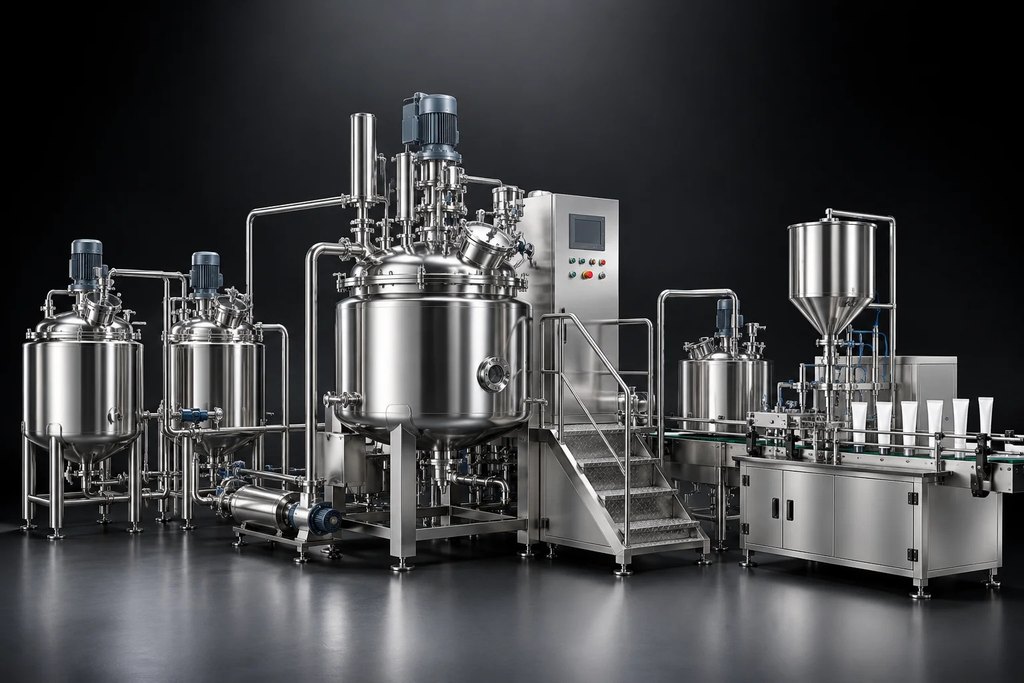
Components of Ointment Manufacturing Plant
Ointment plant is a series of connected vessels and mechanisms designed to melt, mix, homogenize, and transport semi-solid products. The usual configuration includes a wax melting vessel and a water phase vessel. They work well with pharmaceutical ointments, cosmetic creams, gels, and suspensions. The key component is a vacuum mixer where the two phases are emulsified at a certain temperature and reduced air pressure.
Why Supplier Selection is Important Than Price
Two plants may appear equal in brochures, but their performances could be worlds apart. Weld quality, choice of motor, seal type, and precision in control all have an impact on batch-to-batch uniformity. A poor supplier could even leave you high and dry after delivery, without an engineer and even without replacement gaskets. From my experience, people who make decisions based on price end up paying more within two years.
Credentials to Verify
Make sure that product-contact components are made out of SS 316 or SS 304, and that test certificates are available. The plant design should be GMP-compatible, with polished surfaces, tri-clamp connections, and no dead spots. Make sure that they can help you with DQ, IQ, and OQ and with your PQ as well. Ask for ISO or similar credentials that you can actually see.
Specs to Confirm Before Placing Orders
Provide an identical briefing to all the selected suppliers to get comparable quotations. The product catalog may indicate stainless steel material of the equipment in SS 316 or 304 and list various uses in pharmaceuticals, cosmetics, and chemicals; however, the brochure does not tell you the full story. Inquire about the working capacity of each equipment, its actual batch size, vacuum level, homogenizer rate, and heating process. Confirm how the homogenizer enters (bottom or top entry), degree of automation provided (recipe database, loggers, etc.) and requirement of power, steam, and cooling water.
Understanding Public Price Lists
The range of prices in public listings is huge. A price list shows an automatic ointment cream plant at ₹12 lakh per unit, whereas another lists a less-capable ointment plant around ₹4 lakh. The variation in price is due to capacity, build, and equipment included, not the brand. It is always advisable to ask for the exclusions in any quote.
Questioning that will help you find a good supplier
Find out whether you can visit the workshop and do a factory acceptance test, whether they have references from other customers in your industry. Ask about the time of delivery and commissioning, about the duration of warranty period and its contents, and whether spare parts are kept in stock. Moreover, make sure that their engineers will provide training of your operators at the place of work.
Warning signs
Beware when a supplier avoids providing drawings, gives vague information about materials, refuses to let you visit a workshop, and tries to convince you to pay in advance before the technical specifications are agreed. An unusually low quotation without any reason also raises suspicion.
Conclusion
A good ointment manufacturing plant supplier should have good engineering background, correct documentation, and quality support. Compare quotations, check the qualifications of the company, and check their service before making a final decision. You will be pleased with your choice for years to come.

Leave a Reply